




National Security
Published in Association with Vivekananda International Foundation
Current Volume: 9 (2026 )
e-ISSN: 2581-9658
Periodicity: Quarterly
Month(s) of Publication: Mar, Jun, Sep & Dec
Subject: Political Science & International Affairs
DOI: 10.32381/NS
Online access is free for the Research Faculty of VIF
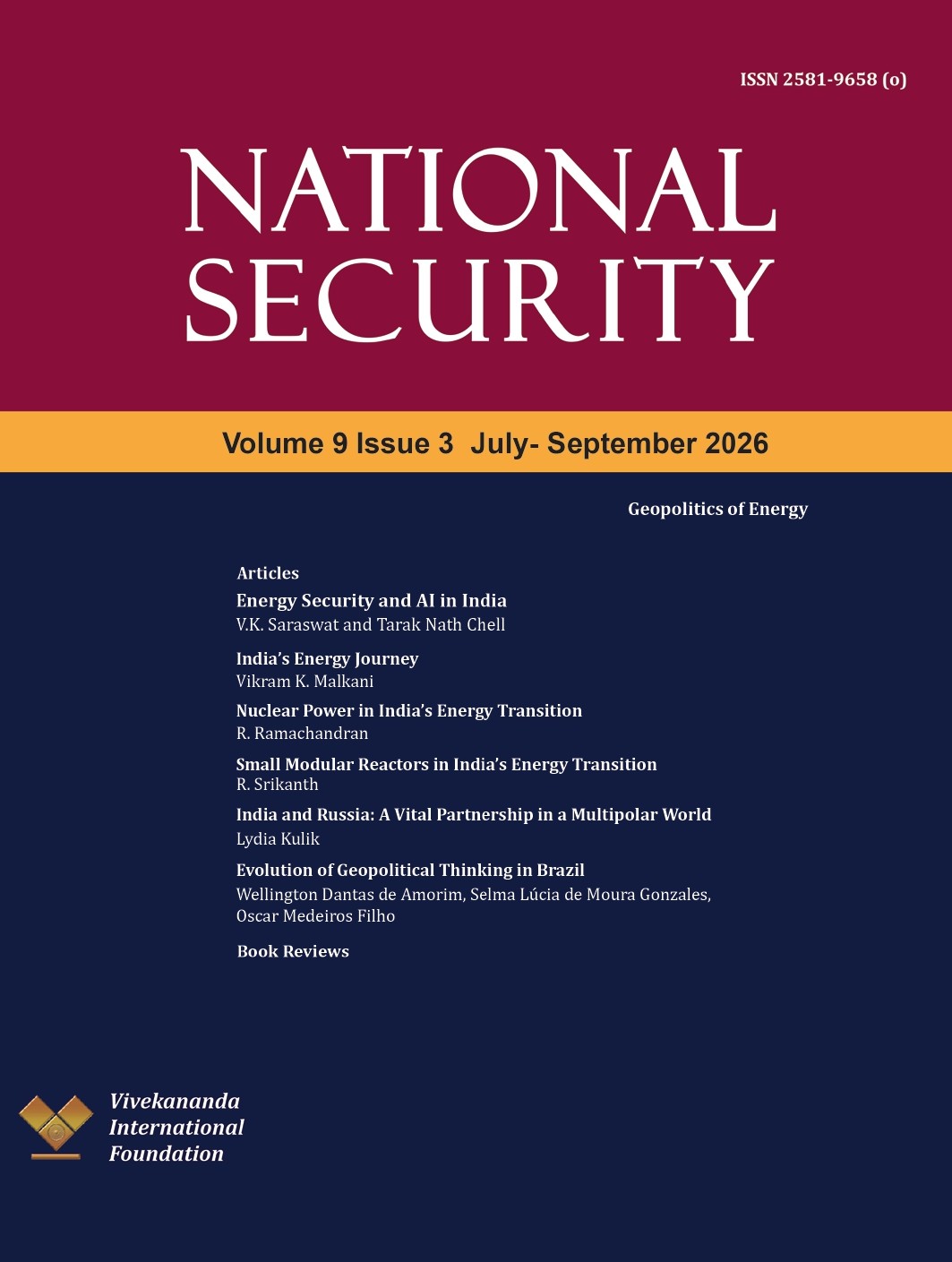
Small Modular Reactors in India’s Energy Transition
By : R. Srikanth
Page No: 409-430
Abstract
Energy Security, Energy Access, and Energy Affordability are key factors for economic development. Deep decarbonisation with clean and firm Nuclear Power Plants (NPPs) that can supply zero-carbon and reliable energy on a 24x7 basis is key for India to reach Net Zero by 2070 with energy security and reliability. The Sustainable Harnessing and Advancement of Nuclear Energy for Transforming India (SHANTI) Act enacted in December 2025, allows private and public sector companies to set up NPPs. As part of National Institute of Advanced Studies (NIAS’s) ongoing work with several companies interested to contribute to India’s Nuclear Energy Mission (NEM), site selection reports have been prepared for 39 candidate sites for NPPs. However, the ultimate suitability of each site for a NPP is subject to the confirmation of the seismotectonic features and the geotechnical aspects of the site, the availability of adequate land and water from the State Government, and public acceptance. Therefore, the Central Government should involve the State Governments and also advise Department of Atomic Energy (DAE) and Atomic Energy Regulatory Board (AERB) to publicise the results of the environmental and health surveys around various NPPs in India. Further, the development of indigenous Small Modular Reactors (SMRs) by Bhabha Atomic Research Centre (BARC) should be expedited to repurpose the land and infrastructural facilities in Thermal Power Plants (TPPs) that can be progressively retired between 2030 and 2050 to install SMRs.
Author
R. Srikanth, Ph.D, is a Professor and Head of Energy, Environment and Climate Change Program at the NIAS Bengaluru, India.
DOI: http://doi.org/10.32381/NS.2026.09.03.4