



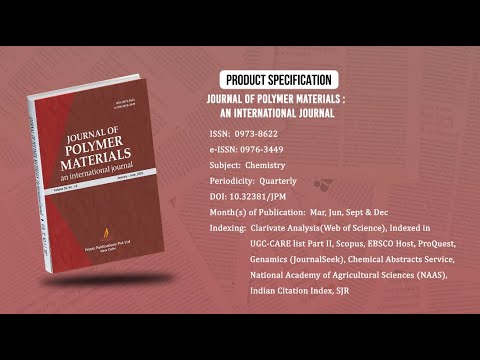
Journal of Polymer Materials : An International Journal
Current Volume: 40 (2023 )
ISSN: 0973-8622
e-ISSN: 0976-3449
Periodicity: Quarterly
Month(s) of Publication: March, June, September & December
Subject: Chemistry
DOI: 10.32381/JPM
Synthesis of poly(w-pentadecalactone) using Lipase Immobilized onto a Renewable Carrier, Rice husk ash and their Characterization
By : Cansu Ulker Turan , Yuksel Guvenilir
Page No: 271-280
Abstract
Rice husk ash is a side-product of rice production; thus, it is a cheap, abundant, and renewable material, and utilized as an enzyme carrier to immobilize Candida antarctica lipase B. In this study, Candida antarctica lipase B immobilized onto rice husk ashes was used to catalyze ring opening polymerization of 16-membered lactone, ?-pentadecalactone. In order to determine the best polymerization conditions for highest molar mass polymer, reactions were proceeded at various temperatures and time periods. The best reaction conditions were obtained as 80°C and 6 hours (Mn= 34255 g mol-1). Molecular structure of this polymer sample was confirmed via proton nuclear magnetic resonance spectroscopy (1H-NMR) and Fourier transform infrared spectroscopy (FTIR). Thermal properties were investigated by differential scanning calorimetry (DSC) and thermal gravimetric analysis (TGA). Consequently, poly(?-pentadecalactone) was synthesized enzymatically with rapid polymerization tendency and improved thermal properties which were quite close to low-density polyethylene. Successful polymerization results showed that Candida antarctica lipase B immobilized onto rice husk ashes may be a good alternative to commercial immobilized form, Novozyme 435, as a result of its comparable activity and low cost.
Authors :
Cansu Ulker Turan
Istanbul Technical University, Department of Chemical Engineering, 34469, Istanbul, Turkey.
Yuksel Guvenilir
Istanbul Technical University, Department of Chemical Engineering, 34469, Istanbul, Turkey.
DOI: https://doi.org/10.32381/JPM.2021.38.3-4.8