


Journal of Psychosocial Research
Current Volume: 21 (2026 )
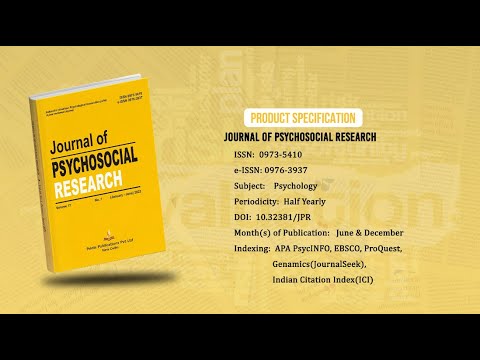
ISSN: 0973-5410
e-ISSN: 0976-3937
Periodicity: Half-Yearly
Month(s) of Publication: June & December
Subject: Psychology
DOI: 10.32381/JPR
Development of Spatial Language in Traditional and Non-traditional School Children
By : Rajesh Kumar Jha
Page No: 401-406
Abstract
There has been anything concretely existing in the world must have some spatial direction or location, therefore the spatial ability seems to be a central aspect of human adaptation and it requires use and transformation of spatial information in certain understandable ways. This paper describes a study carried out with the traditional and non-traditional school students of Varanasi city to explore the development of spatial language. The objective of this study is to explore the development of spatial language in traditional and non-traditional schools children. The study was conducted with 105 students from three different types of school (Sanskrit-medium, Hindi -medium and Urdu- medium schools) at Varanasi city and aged 10-15 years. A number of spatial tasks and procedures (Route Task & Perspective Task) were used to assess the spatial frames of reference students used in describing and interpreting various spatial displays. Traditional school children (Sanskrit & Urdu medium school) used more geocentric language as compared to non-traditional school (Hindi medium school) children in describing and interpreting spatial displays.
Author:
Rajesh Kumar Jha : Assistant Professor, Department of Psychology, DAV PG College, Banaras Hindu University, Varanasi, Uttar Pradesh, India.
DOI: https://doi.org/10.32381/JPR.2024.19.02.20