




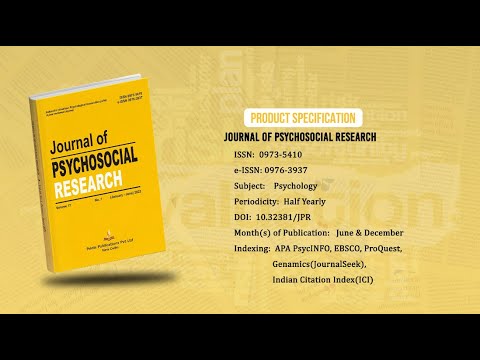
Journal of Psychosocial Research
Current Volume: 21 (2026 )
ISSN: 0973-5410
e-ISSN: 0976-3937
Periodicity: Half-Yearly
Month(s) of Publication: June & December
Subject: Psychology
DOI: 10.32381/JPR
Early Adulthood: The Role of Locus of Control, Meaning of Life and Subjective Well Being
By : Noreen Choudhri , Thiyam Kiran Singh
Page No: 131-139
Abstract
This study examined the difference between individuals with Internal and External Locus of Control in Early Adulthood on the Personal Meaning and the Subjective Well Being. A Random sampling technique was used through which a sample of 120 adults in the age range of 20-23 years were selected out of which 60 were internal locus of control adults and 60 were external locus of control adults. All participants were administered: The General Health Questionnaire Developed by Goldberg (1978), Internal and External Locus of Control Scale Developed by Rotter (1966), Personal Meaning Profile Developed by Wong (1998) and Subjective Well Being Inventory Developed by Nagpal and Sell (1985). The results of the study reflect that there exists a significant difference between groups of internal and external locus of control in early adulthood on the personal meaning and the subjective well being. It was found that internal locus of control adults had a greater meaning in life and higher subjective well being than external locus of control adults.
Authors :
Thiyam Kiran Singh : Assistant Professor and Clinical Psychologist, Dept. of Psychology, AIBAS, Amity University Rajasthan, Jaipur.
Noreen Choudhri : M.Phil, Clinical Psychology Trainee, Dept. of Psychology, AIBAS, Amity University Rajasthan, Jaipur