


Journal of Psychosocial Research
Current Volume: 21 (2026 )
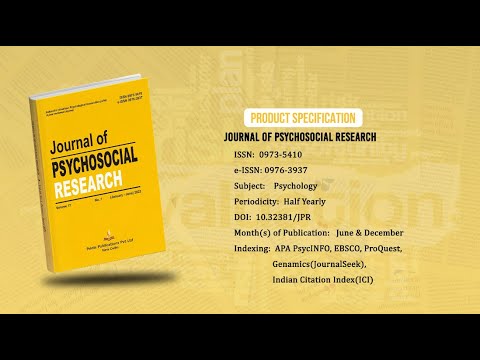
ISSN: 0973-5410
e-ISSN: 0976-3937
Periodicity: Half-Yearly
Month(s) of Publication: June & December
Subject: Psychology
DOI: 10.32381/JPR
Early Childhood Education in Contemporary Indian Society: Finding Meaning through Cultural Traditions and Developmental Science
By : Nandita Chaudhary
Page No: 373-384
Abstract
Local cultural traditions can be argued as adaptive, enduring, and effective ways of living with the environment, and cultural differences in beliefs and practices can be linked to ecological, social, and historical contexts. Using this argument, traditional knowledge and indigenous practices of child care can be argued as adaptive, sustainable and meaningful. Besides folk wisdom, we have access to global information, which is now universally available even from our hand-held devices. Knowledge is dynamic and responsive to changes in society as an outcome of internal and external influences, and it is unreasonable to make any blanket claims either about tradition or about modernity as being absolute and accurate. As humans, we must question everything. Examining the intersection of different sources of information, it becomes evident that there is a tendency to view local practice as folk culture and global information as verified science. However, if we shift perspectives, the separation of science and culture is not absolute, and the opposition between folk belief and global science is misplaced. This paper focuses on a productive combination of science and culture to identify four possible intersections with local and global knowledge for heuristic purposes. These are proposed as overlapping areas of knowledge and activity and not as exclusive or exhaustive domains. In any field of activity, local culture, global science, local science and global culture intersect, where the first two (local culture and global science) are recognized, the third and fourth categories of the model (local science and global culture) are usually ignored since cultural tradition is seen as local and positioned as unscientific, and science as global. The antagonism between these fields of knowledge is an outcome of history, more specifically colonial imperialism,and has been detrimental for sustainable and inclusive advancement. These phenomena will be examined with specific reference to the care and education of young children.
Author :
Nandita Chaudhary : PhD, Child development expert – Retired Faculty, Department of Human Development and Childhood Studies, Lady Irwin College, Delhi University, New Delhi.
DOI: https://doi.org/10.32381/JPR.2020.15.02.1