


Journal of Indian Ocean Studies
Published in Association with Society of Indian Ocean Studies (SIOS)
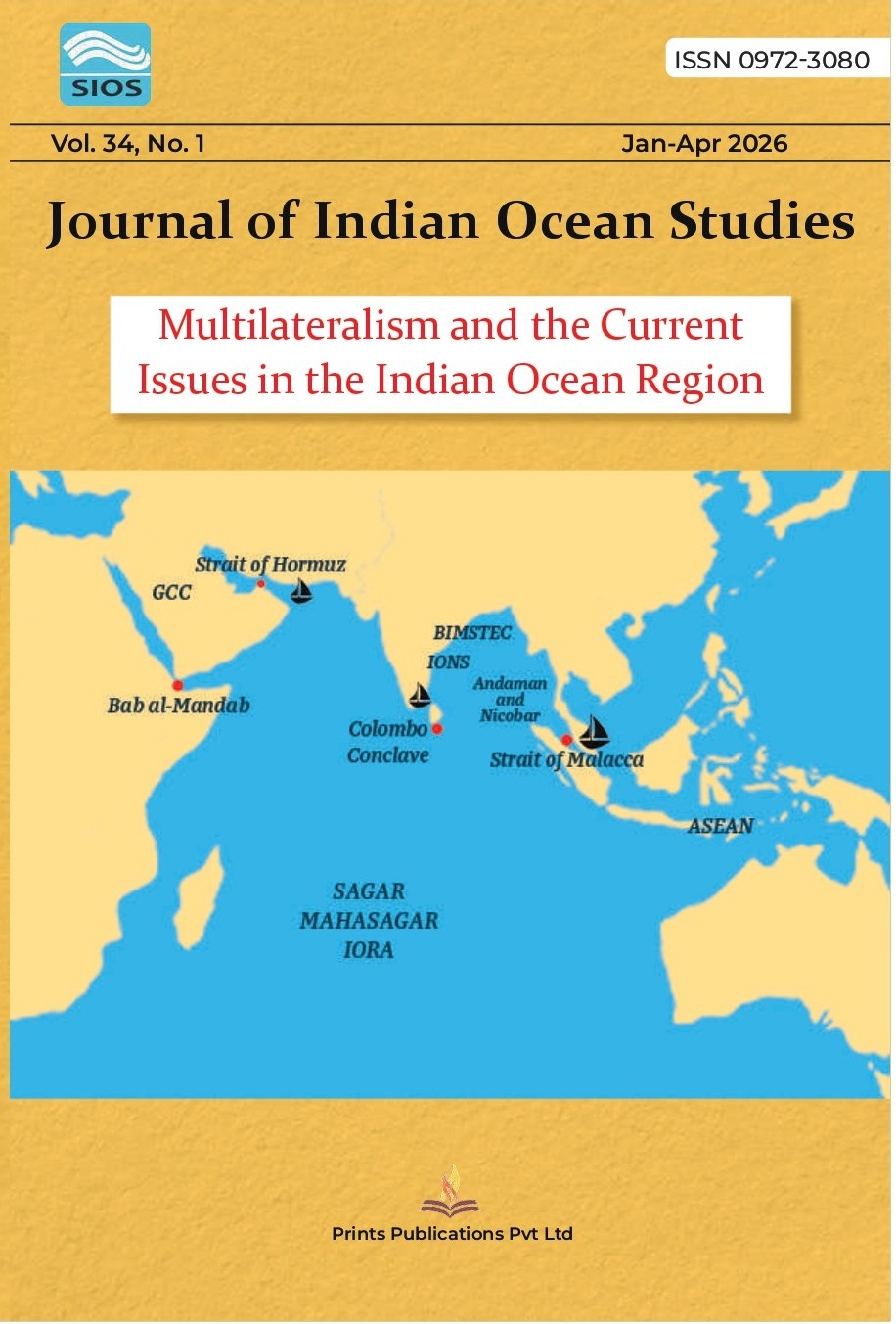
Current Volume: 34 (2026 )
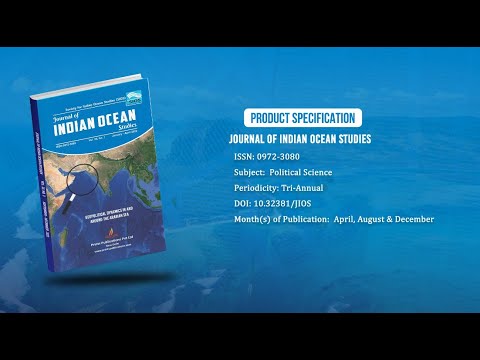
ISSN: 0972-3080
Periodicity: Tri-annual
Month(s) of Publication: April, August & December
Subject: Political Science & International Affairs
DOI: 10.32381/JIOS
Online Access is free for Life Member
India and Geographical Advantages of Indian Ocean Islands
By : Adluri Subramanyam Raju , Udita Banerjee
Page No: 199-209
Introduction
The geographical contours of a country play a preeminent role in the determination of its course of history and the roles and responsibilities it takes up at the international scene. As enunciated pointedly by Hans Morgenthau that “on the relatively stable foundation of geography the pyramid of national power arises.”1 However, Robert D. Kaplan cautions that “geography is merely the unchanging backdrop against which the battle of ideas plays out.”2 Although he cautions against inspiring determinism, he concurs with W.H. Parker in upholding that eventually “in the long run, however, those who are working in harmony with environmental influences will triumph over those who strive against them.”3 As the world gets smaller in the 21st century with spiralling technological modernization, it becomes all the more crucial to know every inch of space better in order to reap benefits and overcome obstacles. And the beginning has to be made with the intimate acquaintance of a nation’s foreign policy with its geography -in a word, its geopolitics. In this vein, this paper calls for a key understanding for India of the geopolitical matrix of the Indian Ocean Region (IOR), the threats characterising the region and its resident countries and their perceptions of India’s policy in carving out a paradigm of Security and Growth for all in the region (SAGAR).
Authors :
Adluri Subramanyam Raju is a Professor & Udita Banerjee is a Research Scholar (UGC JRF) UGC Centre for Maritime Studies, Pondicherry University, India.
DOI: https://doi.org/10.32381/JIOS.2021.29.03.2