


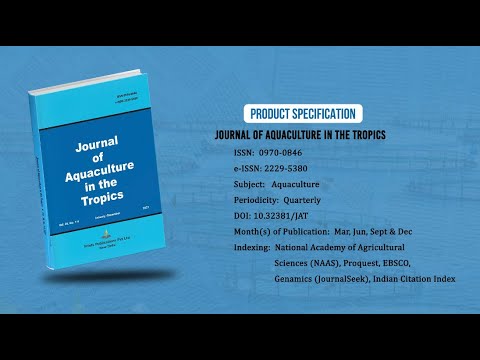
Journal of Aquaculture In the Tropics
Current Volume: 41 (2026 )
ISSN: 0970-0846
e-ISSN: 2229-5380
Periodicity: Quarterly
Month(s) of Publication: March, June, September & December
Subject: Aquaculture
DOI: 10.32381/JAT
Precision Aquaculture – A Data Driven Farming Method for Sustainable Aquaculture
By : Vignesh P , Cheryl Antony , Selvaraj S. , Venkateshwara D.
Page No: 30-38
Abstract
Aquaculture is a rapidly evolving industry that plays a crucial role in global food security. To meet rising demand, sustainable intensification of the industry is essential. Precision aquaculture is an innovative approach to fish farming that integrates real time monitoring, data analytics, automation and targeted interventions. Precision fish farming enhance production efficiency, reduce environmental impact and ensures economic sustainability. The cyclic process of precision aquaculture includes observe, interpretation, decide and act. Potential applications include automated biomass monitoring, feeding control and disease management. The key benefits of precision aquaculture are maximize growth and yield, environmental sustainability, disease mitigation. However, its adoption faces challenges such as high initial setup costs, complexity, the need for skilled personnel and a stable internet connection. By leveraging recent technologies, precision aquaculture ensures the sustainable seafood production while protecting aquatic ecosystems from pollution, benefiting future generations.
Authors
Vignesh P. : PG Scholar, Department of Aquaculture, TNJFU - Dr. M.G.R Fisheries College and Research Institute, Ponneri, Tamil Nadu, India
Cheryl Antony : Director of Research i/c, Tamil Nadu Dr. J. Jayalalithaa Fisheries University, Nagapattinam, Tamil Nadu, India
Selvaraj S. : PG Scholar, Department of Aquaculture, TNJFU - Dr. M.G.R Fisheries College and Research Institute, Ponneri, Tamil Nadu, India
Venkateshwara D. : Assistant Professor and Head i/c, Department of Aquaculture,TNJFU - Dr. M.G.R Fisheries College and Research Institute, Ponneri, Tamil Nadu, India
DOI: http://doi.org/10.32381/JAT.2024.39.1-4.4