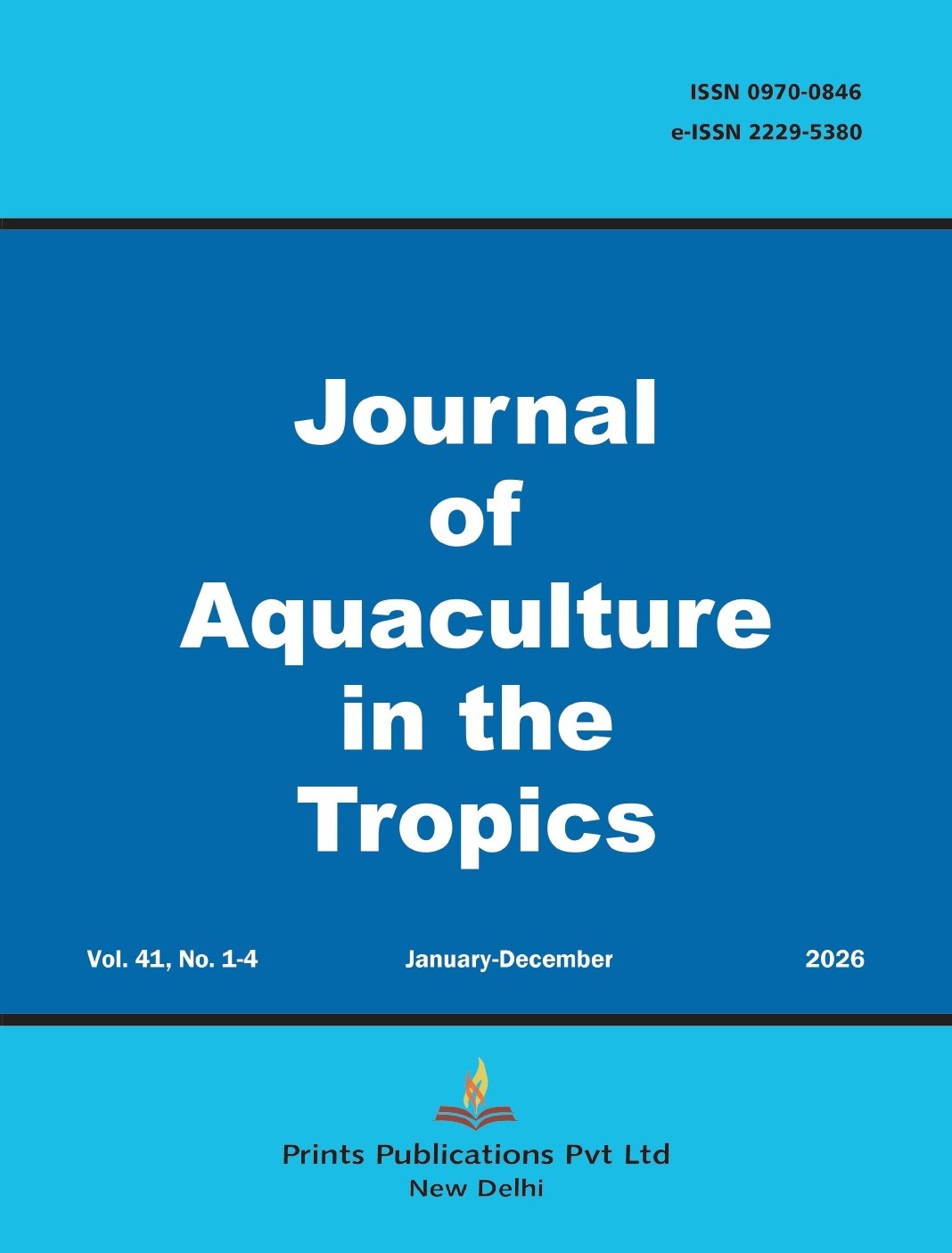


Journal of Aquaculture In the Tropics
Current Volume: 41 (2026 )
ISSN: 0970-0846
e-ISSN: 2229-5380
Periodicity: Quarterly
Month(s) of Publication: March, June, September & December
Subject: Aquaculture
DOI: 10.32381/JAT
Evaluation of Selected Probiotics as Feed Additives in the Formulated Diets of Climbing Perch, Anabas Testudineusin Ponds
By : M. Z. Ali , M. Paul , Y. Mahmud , M. Zaher
Page No: 85-96
Abstract
A 3-month feeding trial was conducted in pond condition to evaluate the effect of selected probiotics as feed additives on growth, feed conversion, protein utilization, production and net profit in Anabas testudineus. Eight experimental ponds each of 400 m2 size were divided into 4 treatment groups each with two replicates. The mean initial weights of fish were 3.60 ± 0.7 g and fish were stocked at the rate of 2,500 fish per pond (62,000/ha). Four experimental diets (iso-nitrogenous and iso-energetic) were formulated to contain 33% crude protein and 16.47 kJ g-1 gross energy for diets 1–4, were tested respectively. A control diet (Diet-1) was prepared with same feed ingredients without probiotic. Fish were fed the experimental diets at the rate of 10-5% of their body weight per day adjusted fortnightly. The results showed that growth rate in terms of mean final body weight, weight gain, percent weight gain of experimental fish fed diets 2-4 were significantly (P<0.05) higher than the control diet. The specific growth rate (SGR) in different experimental diets varied between 3.14 and 3.39, with diets 2-4 producing higher (3.39) SGR value. The feed conversion ratio (FCR) values of different experimental diets ranged between 1.88 and 2.03 with diets 2-4 producing the better FCR. Protein efficiency ratio (PER) in different experimental diets ranged between 2.05 and 2.18 and the lowest PER value was obtained with diet 1 (control). The production of Anabas testudineus ranged between 3,350 to 4,270 kg/ha/3 months with probiotics containing diets results the highest production. A simple economic analysis showed that fish fed with probiotics containing diets resulted in the highest net profit. The carcass protein content in different diets ranged between 17.06% and 19.69%. Fish fed diet 2 showed significantly (P<0.05) highest protein content and diet 1 the lowest. This study revealed that feed incorporated with the probiotics may be used as a fish feed in Anabas testudineus culture, to enhance fish health, better feed efficiency and growth performance.
Authors :
M. Z. Ali, M. Paul, Y. Mahmud And M. Zaher
Bangladesh Fisheries Research Institute Freshwater Station, Mymensingh-2201