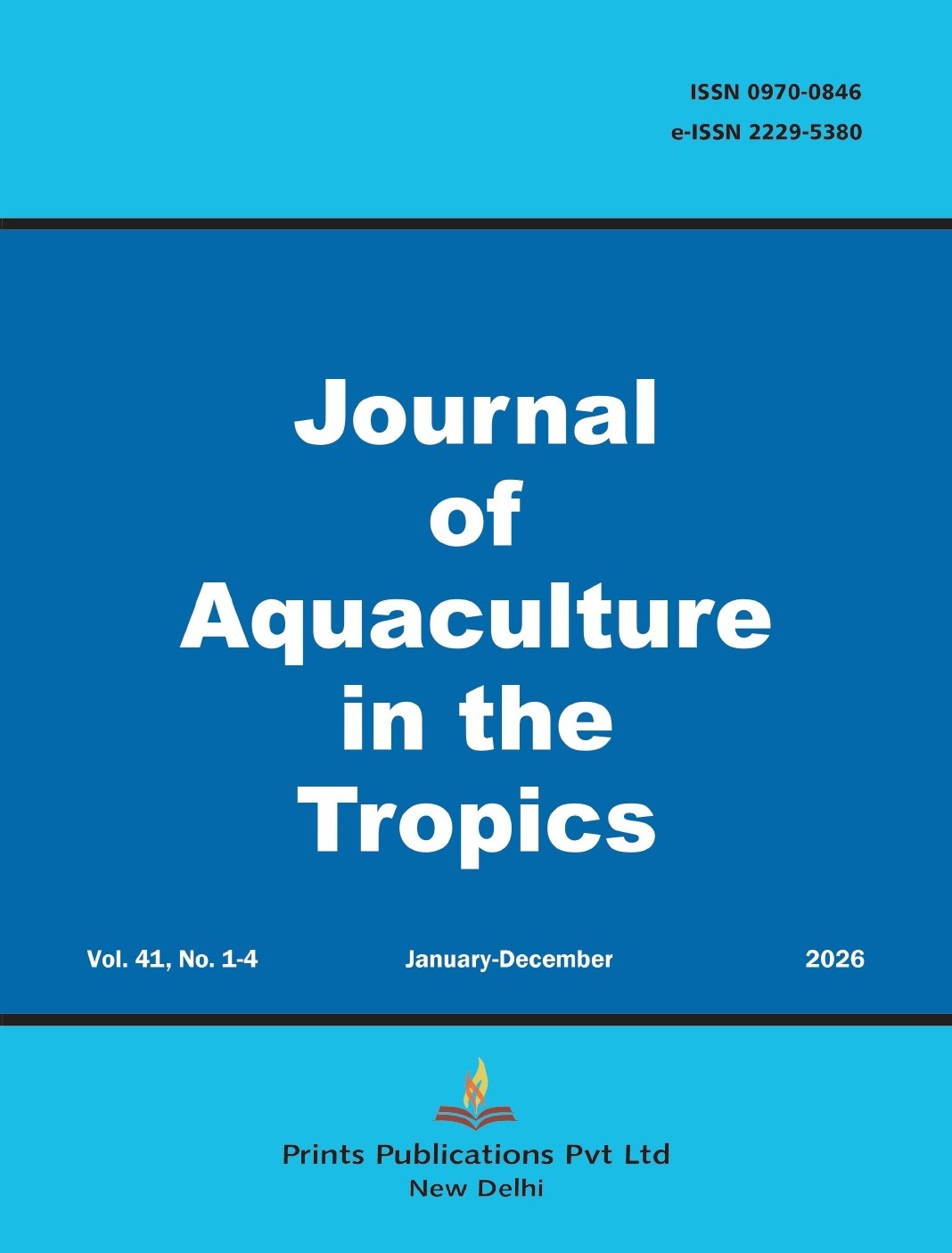


Journal of Aquaculture In the Tropics
Current Volume: 41 (2026 )
ISSN: 0970-0846
e-ISSN: 2229-5380
Periodicity: Quarterly
Month(s) of Publication: March, June, September & December
Subject: Aquaculture
DOI: 10.32381/JAT
Periphyton-based Polyculture of Jaraqui,Semaprochilodus insignis (Schomburgk, 1841) and Tambaqui, Colossoma macropomum (Cuvier, 1816) with Feed Supplementation
By : S.A.R. Tortolero , B.A.S. Cavero , J.L. Silvajunior , J.G. Brito , C.C. Soares , P. Keshavanath , H.T.B. Barbosa , B. Gangadhar
Page No: 111-132
Abstract
The effect of feed vs. feed plus two substrates, a macrophyte (Pistia stratiotes) and plastic screen, on the performance of jaraqui (Semaprochilodus insignis) and tambaqui (Colossoma macropomum) was evaluated under polyculture. Jaraqui of 14.84-18.05 g and tambaqui of 4.32-4.60 g initial average weight were stocked in triplicate at 1 fish per m2 in the ratio 70:30 in masonry tanks of 46 m2 , with an average depth of 70 cm. The tanks were fertilized with urea, triple superphosphate and wheat bran. A commercial feed containing 36% protein was provided to satiation in the control and treatment tanks every morning in plastic trays suspended in the water column. Macrophyte supported higher periphyton biomass, while protein content was higher in periphyton grown on plastic screen. On termination of the 90-day culture, jaraqui reached a final weight of 34.32 g in the plastic screen treatment as against 22.89 g in the macrophyte treatment and 27.44 g in the control. Tambaqui grew to 137.36 g and 139.68 g size in macrophyte and plastic screen treatments respectively, both being marginally higher than that of the control, which recorded a final weight of 117.54 g. Survival of jaraqui and tambaqui ranged from 89.90% to 100% and 82.05% to 100%, respectively. The water quality parameters measured were generally within the acceptable range for fish culture.
Authors :
S.A.R. Tortolero
Instituto Federal de Educação do Amazonas, Manaus Campus, Brazil
B.A.S. Cavero and J.L. Silvajunior
Universidade Federal do Amazonas, Manaus, Brazil.
J.G. Brito, C.C. Soares and P. Keshavanath
Instituto Nacional de Pesquisa da Amazônia (INPA), Manaus, Brazil
H.T.B. Barbosa
Instituto Federal de Educação do Amazonas, Presidente Figueiredo Campus, Brazil.
B. Gangadhar
Peninsular Aquaculture Division, ICAR Central Institute of Freshwater Aquaculture, Bengaluru, India.