


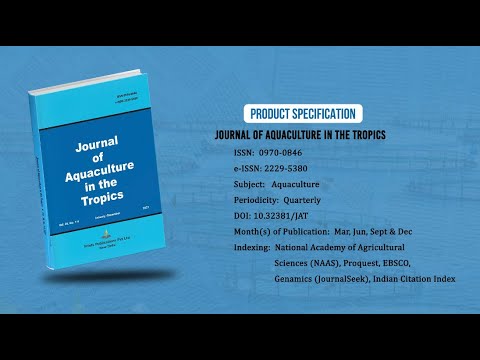
Journal of Aquaculture In the Tropics
Current Volume: 41 (2026 )
ISSN: 0970-0846
e-ISSN: 2229-5380
Periodicity: Quarterly
Month(s) of Publication: March, June, September & December
Subject: Aquaculture
DOI: 10.32381/JAT
Third generation Biofuel Production from the Seaweeds: an Indian perspectives
By : Sathish Chennuri , Kranthi Rekha Mukkeri , Karan Kumar Ramteke
Page No: 17-25
Abstract
The progressive decline of fossil fuels reserves and their associated harmful effects such as global warming and the demand for energy is expected to increase over the following years to come which results in searching for new sustainable environmentally friendly fuels which are known as biofuels. 3rd generation biofuels sources such as seaweeds do not compete with food crops and don’t require agrarian land for cultivation and numerous species grow in brackish or salt water maintaining a strategic distance from rivalry for land and fresh water required for food production. Seaweeds are considered as among the most potentially noteworthy future sources of sustainable biofuels. In India, seaweed grows in large quantities along the coast of Tamil Nadu, Gujarat, and in specific locales of Lakshadweep, and the Andaman and Nicobar islands. There are likewise exceptionally rich seaweed diversity along the coast lines of Mumbai, Ratnagiri, Goa, Karwar, Varkala, Vizhinjam, Pulicat, and Chilka. There are different methods by which fuel can be extracted (i) direct combustion, (ii) pyrolysis, (iii) gasification (conventional), (iv) trans-esterification of seaweed oils to biodiesel (v) hydrothermal treatments, (vi) fermentation to bioethanol, (vii) ABE fermentation to biobutanol and (viii) anaerobic digestion. India, with a tremendous coastline can be a resourceful and renewable source for seaweed cultivation and biofuel generation. Certain fundamental factors, such as use of potential species, its cultivation method, yield per hectare, time and method of harvest, energy yield, and cost of fuel production need to be carefully researched for successful foundation of commercial biofuel reactor.
Authors:
Sathish Chennuri, Kranthi Rekha Mukkeri and Karan Kumar Ramteke
ICAR- Central Institute of Fisheries Education, Mumbai
DOI: http://doi.org/10.32381/JAT.2019.34.1-2.2