



Indian Foreign Affairs Journal
Published in Association with Association of Indian Diplomats
Current Volume: 21 (2026 )
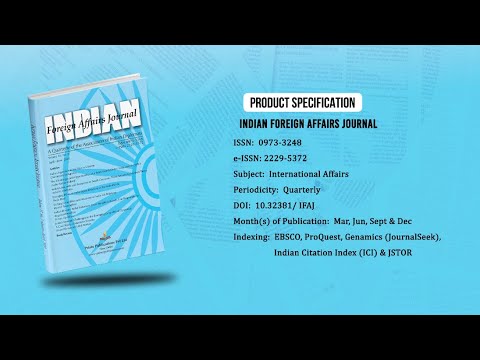
ISSN: 0973-3248
e-ISSN: 2229-5372
Periodicity: Quarterly
Month(s) of Publication: March, June, September & December
Subject: Political Science & International Affairs
DOI: 10.32381/IFAJ
Reorienting India-Nepal Relations for an Aspirational Nepal at the Crossroads of History
By : Atul K. Thakur
Page No: 153-163
Abstract
In the wake of unprecedented political shifts in Nepal and the toughest transition it is confronting as of now, India needs a new prism to view its relationship with its Himalayan neighbour, keeping in mind the past, present, and the future possibilities. In a new democracy, with a deep footprint of active monarchy for about two hundred-forty years, Nepal’s position is uniquely shaped as it offers enough room to look back as much as to look ahead. The broad disillusionment from chronic misgovernance, rampant corruption, and thriving nepotism — added with a gag order of banning social media apps by the KP Oli government followed by a shootout order on the protesting youth (Generation Z or Gen Z) — caused the losses of precious lives (nearly eighty young protesters died, and over five hundred were badly injured) that finally triggered the mass scale nationwide vandalism, targeting party offices, politicians’ houses and symbols of power centres (including Singha Durbar, Parliament Building, Supreme Court), commercial establishments, and the headquarters of Nepal’s leading media group. As the Great Game 2.0 begins in a shaky Nepal, India has to reorient its Nepal policy keeping in view the new challenges at the strategic and economic fronts. This essay focuses broadly on the new realities offered by a new and aspirational Nepal, and the ways to reboot India’s bilateral relations with Nepal
Author
Atul K. Thakur is a policy professional, columnist and writer. His latest book (co-authored), “Kathmandu Chronicle: Reclaiming India-Nepal Relations; Penguin Random House India”, offers unique insights on Nepal and India-Nepal Relations. The views expressed are personal.
DOI: https://doi.org/10.32381/IFAJ.2025.20.2.5