



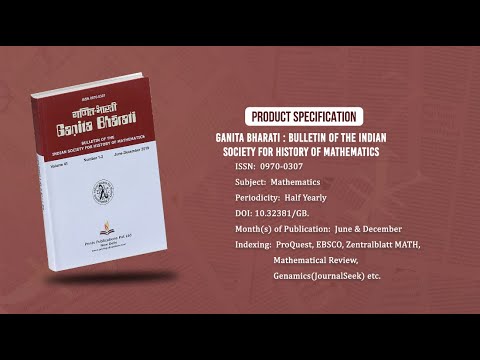
Ganita Bharati
Published in Association with Bulletin of The Indian Society for History of Mathematics
Current Volume: 45 (2023 )
ISSN: 0970-0307
Periodicity: Half-Yearly
Month(s) of Publication: June & December
Subject: Mathematics
DOI: https://doi.org/10.32381/GB
Online Access is Free for Life Member
New Perspectives on the Development of the Indian Positional System in the Light of Sanskrit, Pāli and Tamil Sources
By : Satyanad Kichenassamy
Page No: 1-21
Abstract
We show that the Indian number system, now in nearly universal use, was preceded by a system capable of expressing arbitrarily large numbers using only twelve symbols, and no zero, the last three symbols serving as place separators. It is alluded to by Brahmagupta in 628 under the name gomūtrikā that, later on, took a different meaning. It is very similar to the standard Indian way of writing equations. The turning point seems to have been the introduction of visual patterns in Sanskrit poetry. There are also traces of it in Pāli grammar as well as in Tamil mathematics. In Tamil, this system was extended to express arbitrarily small fractions. We suggest that the place separators were eventually omitted as a result of the development of methods for root extraction and of avyakatagaṇita or algebra.
Author
Satyanad Kichenassamy : Professor of Mathematics, Université de Reims Champagne-Ardenne, Laboratoire de Mathématiques de Reims (CNRS, UMR9008), B.P. 1039, F-51687 Reims Cedex 2.
DOI: https://doi.org/10.32381/GB.2023.45.1.1