



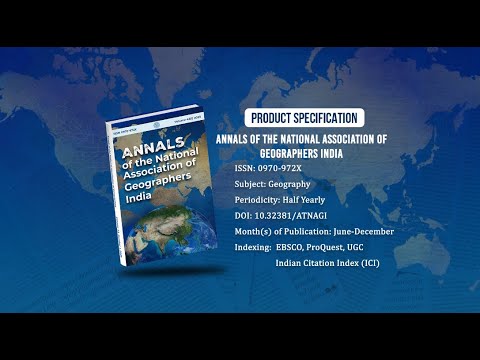
Annals of the National Association of Geographers India - A UGC-CARE Listed Journal
Published in Association with National Association of Geographers, India (NAGI)
Current Volume: 46 (2026 )
ISSN: 0970-972X
Periodicity: Half-Yearly
Month(s) of Publication: June & December
DOI: https://doi.org/10.32381/ATNAGI
Online Access is Free for All Life Member of NAGI
Impact of Climate Change and Vulnerabilities among Elderly Women: A Critical Review of Assam, North-East India
By : Manaswita Dutta , Nandini C. Singh , Dipak Sharma
Page No: 344-355
Abstract
In recent years, climate change has emerged as the most impressive challenge worldwide, generating food shortages and hunger as a persistent threat to survival for millions and stands as a collective burden transcending political and social boundaries of nations. Changing rainfall patterns, rapidly rising temperatures, melting glaciers, and erratic seasons are issues that intensify concerns globally as these phenomena are not restricted to any nation, region, state, or within limited political boundaries. What makes it more imbalanced is the disparity in the implementation of policy measures and affordability to mitigate the impact caused by these phenomena across the nations of the world. While the developed countries, through various technologies and infrastructural development, are equipped to face the resultant vulnerability, the developing countries, lacking these facilities on a proper scale, continue to be most affected by the consequences of a changing climate and associated disasters. The sphere of challenges includes not only the environmental facets but also the socioeconomic factors that determine the capacity to face and manage the consequential situation. Thus, it becomes obvious that climate change poses a fundamental threat to places, species, and people’s livelihoods. However, what makes it more hazardous is the fact that the climate crisis is not “gender neutral”, and given the nature of life and livelihood of the women, particularly in rural societies, the impact of climate change exceeds worldwide among women, thereby intensifying already existing inequalities and posing more difficult conditions for their health and safety. However, what draws attention is the fact that these survival conditions become more intense in the cases of elderly women who become more affected as they have unequal capabilities and opportunities for adjustments in comparison to the younger age groups, which eventually renders them as more vulnerable to the regional and global environmental crisis manifested in the form of various issues related to health, dependability, disabilities, and poverty. Further, their limitations in owning economic resources and feeble participation in the decision-making process make the conditions more restrictive. The present paper is an attempt to assess these issues that predominate the life of elderly women with special reference to Assam.
Authors
Manaswita Dutta: Department of Geography, Rajiv Gandhi University, Rono Hills, Arunachal Pradesh.
Nandini C. Singh: Department of Geography, Rajiv Gandhi University, Rono Hills, Arunachal Pradesh.
Dipak Sharma: Department of Geography, Rajiv Gandhi University, Rono Hills, Arunachal Pradesh.
DOI: https://doi.org/10.32381/ATNAGI.2025.45.02.7