






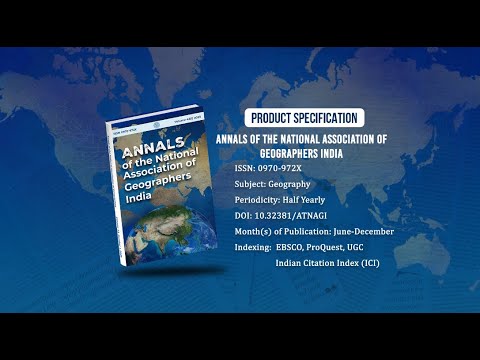
Annals of the National Association of Geographers India - A UGC-CARE Listed Journal
Published in Association with National Association of Geographers, India (NAGI)
Current Volume: 46 (2026 )
ISSN: 0970-972X
Periodicity: Half-Yearly
Month(s) of Publication: June & December
DOI: https://doi.org/10.32381/ATNAGI
Online Access is Free for All Life Member of NAGI
India’s Domestic Climate Policy: Past, Present and Future Strategies
By : Manoranjan Ghosh , Somnath Ghosal
Page No: 156-175
Abstract
It has been proven that the development of any nation is correspondingly related to increasing greenhouse gases and per capita energy demand and uses. In India, approximately nineteen thousand eight hundred villages are still without electricity, and at the same time, India is the world's thirdlargest greenhouse gas emitter. Soon, greenhouse gas emissions and energy demand will be more than double in India. Therefore, India needs an effective and inclusive climate policy to handle high greenhouse gas emissions and meet energy demand. In this article, looking into the past of the Indian domestic climate policy, it has appeared that the country's climate policy is changing over time, especially from 2009 onwards. After briefly examined major achievements and shortfalls of India’s domestic climate policy, especially, National Action Plan on Climate Change, it has cleared that not all the national missions effectively successful. For example, the National Mission on Sustainable Habitat only reframes some existing laws; there are no particular plans for rural habitats in the context of climate change. National Mission for Enhanced Energy Efficiency and National Mission for Sustaining the Himalayan Ecosystem achievements are negligible. Moreover, the state-wise performances on the implementation of eight national missions, there are skewed distributions of financial allocation. However, all missions are equally essential to mitigate the vulnerabilities of climate change. However, there are many shortfalls and lacks in climate policy; nonetheless, India is putting the climate change policy at the heart of development strategies, particularly in energy security and economic development.
Authors :
Manoranjan Ghosh
Doctoral Fellow at Centre for Rural Development and Innovative Sustainable Technology, Indian Institute of Technology Kharagpur, Kharagpur -721302, West Bengal, India.
Somnath Ghosal
Assistant Professor at Centre for Rural Development and Innovative Sustainable Technology, Indian Institute of Technology Kharagpur, Kharagpur -721302, West Bengal, India.
DOI: https://doi.org/10.32381/ATNAGI.2021.41.01.10