



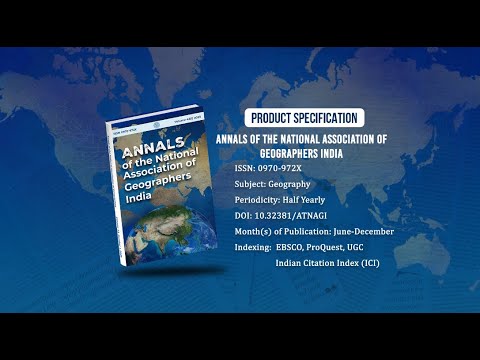
Annals of the National Association of Geographers India - A UGC-CARE Listed Journal
Published in Association with National Association of Geographers, India (NAGI)
Current Volume: 46 (2026 )
ISSN: 0970-972X
Periodicity: Half-Yearly
Month(s) of Publication: June & December
DOI: https://doi.org/10.32381/ATNAGI
Online Access is Free for All Life Member of NAGI
A District Level Rural Vulnerability Assessment in Uttar Pradesh – An Analytic Hierarchy Approach (AHP)
By : Deepika Vashishtha , Shahab Fazal
Page No: 467-495
Abstract
India is predominantly a rural country. Although, the number of urban population is constantly rising, however, it is expected that over 50 percent of the world’s population will remain rural by 2050. Majority of this population depends directly or indirectly on primary economic activities for gaining their livelihoods. However, increasing livelihood vulnerability has become a prime concern as it badly affects livelihood sustainability and rural economy. Thus, identifying poor and marginalized rural population is important to understand and assess various sources of rural vulnerability. It also assists policymakers in the process of prioritisation and planning. In this paper, an attempt has been made to assess district-wise rural vulnerability in Uttar Pradesh (U.P). It primarily employs secondary sources of data. Rural vulnerability is measured as a combination of four-dimensional approach, i.e., Social, Economic, Healthcare and Agriculture Vulnerability. Analytic hierarchy process and weighted method in GIS environment is employed to obtain conceptual framework. Finally, the aggregate of these four indices resulted in the formation of composite rural vulnerability index. Findings reveal that majority of the central, southern and eastern districts are more vulnerable than their northern and western counterparts mainly due to poor connectivity, high percentage of male-female employment disparity, lower assets possession, agricultural productivity, inadequate health centres and high infant mortality rate.
Authors :
Deepika Vashishtha
Research Scholar, Department of Geography, Aligarh Muslim University, Aligarh.
Shahab Fazal
Department of Geography, Aligarh Muslim University, Aligarh.
DOI: https://doi.org/10.32381/ATNAGI.2022.42.02.14