



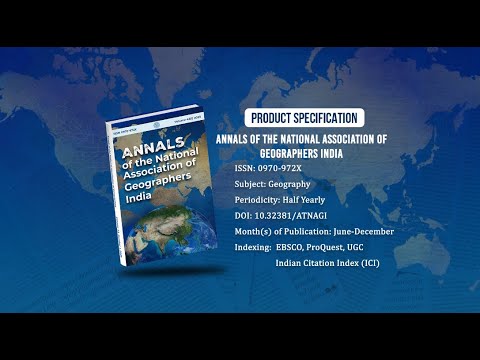
Annals of the National Association of Geographers India - A UGC-CARE Listed Journal
Published in Association with National Association of Geographers, India (NAGI)
Current Volume: 46 (2026 )
ISSN: 0970-972X
Periodicity: Half-Yearly
Month(s) of Publication: June & December
DOI: https://doi.org/10.32381/ATNAGI
Online Access is Free for All Life Member of NAGI
Assessment of Spatio-Temporal Analysis in Sariska Tiger Reserve, India
By : Vivek Raj Singh Chauhan , Lalit Singh Jhala
Page No: 96-111
Abstract
Land use/Land cover analysis plays a vital role in understanding the dynamics of ecosystems and their implications for biodiversity conservation. This study focuses on the Sariska Tiger Reserve (STR), a significant protected area in Alwar, Rajasthan, known for its rich biodiversity and as a crucial habitat for the endangered Royal Bengal tiger (Panthera tigris tigris). The objective of this research is to analyse the spatio-temporal pattern of Land use/cover change within the STR and assess their impact on the reserve’s ecosystems. Remote sensing data, Landsat images from 2001 and 2022, have been utilised to map and quantify land use and land cover change over the past two decades. These data acquired have been processed using image classification techniques and change detection algorithms. The study reveals significant alterations in the land use and land cover pattern within the STR. Conversion of scrub forest into dense forest (7.08%), expansion of dense forest (8.37%), open forest (2.50%), fallow land (5.17%) and settlement (0.51%) have been prominently seen in 2022. The loss of forest cover (scrub forest) possesses a potential threat to the habitat suitability for the tigers and other wildlife species due to anthropogenic activities. Effective planning afforestation and reforestation by Department of forest leads to significant increase in dense forest and open forest in Talvriksh, Tehla, Ajabgarh, Akhbarpur, Bala quila ranges. Additionally, the analysis investigates the STR, considering factors such as, agricultural expansion, tourism activities and water resource management. The study shows increase in water body (0.33%) in 2022 but still a lot need to be done to conserve lakes like Mangalsar, Mansarovar, Jaisamand. The study could be useful for Eco-tourism purpose highlightingkey places in STR region which have immense tourism potential while also aiming to reduce forest resource exploitation by local communities and create employment opportunities for them.
Authors
Vivek Raj Singh Chauhan, UGC-JRF Research Scholar, Department of Geography, Jai Narain Vyas University, Jodhpur (Rajasthan).
Lalit Singh Jhala, Assistant Professor, Department of Geography, Jai Narain Vyas University, Jodhpur (Rajasthan).
DOI: https://doi.org/10.32381/ATNAGI.2025.45.01.6