



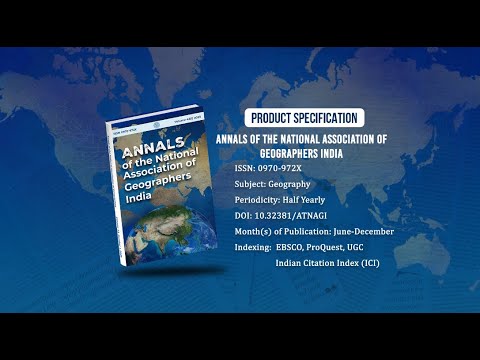
Annals of the National Association of Geographers India - A UGC-CARE Listed Journal
Published in Association with National Association of Geographers, India (NAGI)
Current Volume: 46 (2026 )
ISSN: 0970-972X
Periodicity: Half-Yearly
Month(s) of Publication: June & December
DOI: https://doi.org/10.32381/ATNAGI
Online Access is Free for All Life Member of NAGI
Reimagining India’s Role in a Changing Global Order: Prospects and Challenges for a Soft Power Ascent
By : Surinder Aggarwal
Page No: 24-38
Abstract
The paper explores and examines India’s evolving role in a rapidly transitioning global order characterised by multipolarity, regional fragmentation, and a weakening liberal globalisation framework. As the world transitions from unipolarity toward complex, multipolar alignments, emerging economies—particularly those of the Global South—are asserting greater influence in global governance and power sharing. India, as a major democratic and demographic power, stands at strategic crossroads. Drawing on five structural shifts—emerging economies’ demand for power redistribution, the escalation of conflicts, the resurgence of nationalism, demographic transitions, and technological disruption—the paper situates India within a broader realignment of global institutions and multilateral forums like G20 and BRICS+. BRICS+ is essentially emerging a power sharing and negotiating platform between the exploited Global South and Western hegemonic economies and financial systems. The study argues that India’s ascent as a global actor will depend not solely on hard power but also on its capacity to deploy soft power through a robust knowledge economy, inclusive development, and cultural diplomacy. The paper critically assesses India’s structural strengths—youthful population, technological innovation, and diasporic influence—alongside challenges such as inequality, underinvestment in R&D, and governance constraints. Ultimately, it calls for a strategic and values-based approach. This is achievable by positioning India as a co-leader in a multipolar world order through a reimagined knowledge economy, digital innovation, inclusive development, and a sound foreign policy that showcases regional solidarity, trusted leadership, and democratic credibility. Look East policy can align India towards regional solidarity and strategic partnerships to bolster its regional and global image as a major power.
Author
Surinder Aggarwal, Former Professor of Geography, University of Delhi and ICSSR National Fellow.
DOI: https://doi.org/10.32381/ATNAGI.2025.45.01.2