



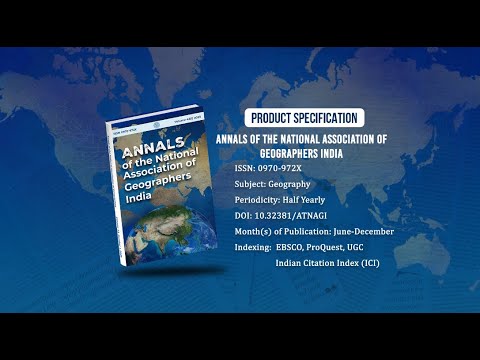
Annals of the National Association of Geographers India - A UGC-CARE Listed Journal
Published in Association with National Association of Geographers, India (NAGI)
Current Volume: 46 (2026 )
ISSN: 0970-972X
Periodicity: Half-Yearly
Month(s) of Publication: June & December
DOI: https://doi.org/10.32381/ATNAGI
Online Access is Free for All Life Member of NAGI
Educational Disparities among Selected Villages in the North Kashmir Region of India
By : Amarjeet Singh , Rayees Ahmed , Pervez Ahmad , Harmeet Singh
Page No: 290-306
Abstract
Education serves as a fundamental cornerstone for both progress and empowerment. Having a comprehensive understanding of the state of education within this region is imperative for making well-informed policies that contribute to long-term advancement. This research investigates the educational achievement levels in the north Kashmir area during the 2021-22 time period. The study relies on primary data gathered through village-level surveys, employing the Stratified random sampling technique. To assess educational progress, both the percentage method and the Z-test were employed. The study highlights that educational attainment within North Kashmir exhibits disparities at the village level, primarily stemming from variations in educational infrastructure and overall development. The union territories enjoy superior access to educational institutions, higher gross enrolment ratios, urbanization rates, and reduced poverty levels, resulting in better educational achievement. The findings of this study provide a nuanced understanding of the opportunities and challenges associated with educational attainment in the villages of north Kashmir. This knowledge can be harnessed by policymakers, educators, and development experts to formulate targeted interventions tailored to the unique requirements of these communities. The ultimate objective is to ensure inclusive and equitable education for all individuals in this culturally diverse and strategically significant region.
Authors:
Amarjeet Singh, Rayees Ahmed, Pervez Ahmed And Harmeet Singh
Department of Geography and Regional Development, School of Earth and Environmental Sciences, University of Kashmir, Srinagar, Jammu & Kashmir, India.
DOI: https://doi.org/10.32381/ATNAGI.2024.44.02.4