



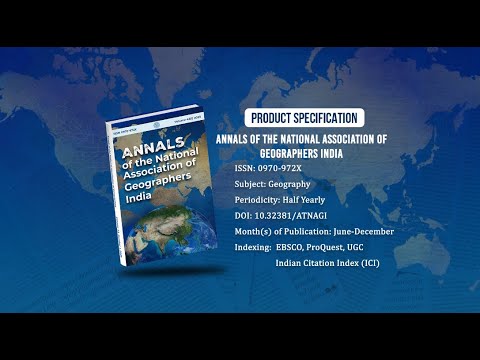
Annals of the National Association of Geographers India - A UGC-CARE Listed Journal
Published in Association with National Association of Geographers, India (NAGI)
Current Volume: 46 (2026 )
ISSN: 0970-972X
Periodicity: Half-Yearly
Month(s) of Publication: June & December
DOI: https://doi.org/10.32381/ATNAGI
Online Access is Free for All Life Member of NAGI
Regional Patterns of Rural-Urban Migration in Uttar Pradesh: Insights from Census 1991-2011
By : Alok Kumar Choubey , Gayarti Rai
Page No: 94-109
Abstract
The present study attempts to analyse the trend, causes and regional patterns of rural-urban migration in the state of Uttar Pradesh for the period 1991-2011. Gender and distance perspective of rural urban migrants are also examined in the study. The paper is exclusively based on secondary sources of data, obtained from Census of India’s Migration D-series tables. Comprehensive regional-temporal analysis of rural to urban migration in the state is presented by taking into account the duration and reasons of migration. Districts are grouped into 4 regions on the basis of their cultural and geographical homogeneity. Migration rates are estimated for each spatial unit to understand regional and gender variations in rural-urban migration within the state. ArcGIS and spreadsheet application have been used for mapping and calculation respectively. Overall analysis of the study reveals that volume of rural-urban migration in the state has doubled in the last 20 years (65.95 lakhs in 2011) with male migrants registering higher growth. In terms of distance preference, intra-district migration has gradually overtaken inter-district migration and migrants are favouring long duration stay after migration. As regards to reasons for migration, economic and social causes continues to control movement of male and female migrants respectively with 62.46 per cent females reporting marriage and 46.65 per cent of male migrants reporting employment as their reason to migrate (2011). Districts of Bundelkhand region witnessed highest migration rates among all spatial units, also females had overwhelmingly higher migration rates throughout state. It was observed that smaller towns were increasingly preferred over metropolitan centres by rural migrants.
Authors :
Alok Kumar Choubey : Research Scholar, Department of Geography, Institute of Science, Banaras Hindu University, Varanasi- 221005.
Gayatri Rai : Associate Professor, Department of Geography, Institute of Science, Banaras Hindu University, Varanasi- 221005.
DOI: https://doi.org/10.32381/ATNAGI.2020.40.01.7