



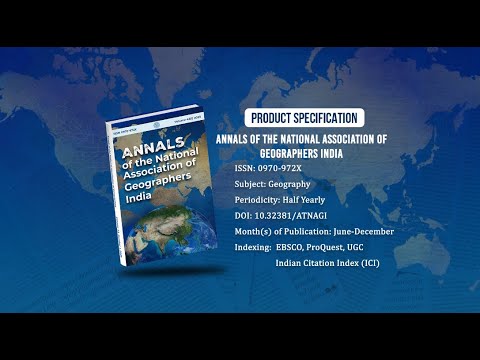
Annals of the National Association of Geographers India - A UGC-CARE Listed Journal
Published in Association with National Association of Geographers, India (NAGI)
Current Volume: 46 (2026 )
ISSN: 0970-972X
Periodicity: Half-Yearly
Month(s) of Publication: June & December
DOI: https://doi.org/10.32381/ATNAGI
Online Access is Free for All Life Member of NAGI
Regional Dimension of Crime against Women in India
By : Manju Sharma , Sandeep Kumar
Page No: 110-127
Abstract
Development is nothing for any country without the safety, happiness and respect of its people, especially children and women. Any violence alters sufferers' physical and psychological status and generates feelings of fear, dishonesty, and immorality in the related community. Contrary to this, the violence-free milieu in any nation signifies its social and economic prosperity. Whether inside or outside the threshold, the violence or crime incidences against women are incredibly apprehensive for India. The study desires to analyze the temporal variations in some such selected incidents. To determine the level of accountability of different sources, the authors tried to establish the correlation between particular crime happenings and their determinants. The secondary information findings reveal that most Indian women undergo mental and emotional torture and cruelty in their households, either by husbands or their relatives, rather than any other crime. Moreover, assaulting, kidnapping, abduction, and rapes are significant outdoor concerns. In terms of population and area, the bigger states recorded the highest criminal incidents against women, but the condition is not better in economically and socially developed states.
Authors :
Manju Sharma : Assistant Professor, Department of Geography, Dayanand College, Hisar, Affiliated to Guru Jambheshwar University of Science and Technology, Hisar-125001, India.
Sandeep Kumar : Assistant Professor, Department of Geography, Institute of Integrated and Honors Studies, Kurukshetra University, Kurukshetra-136119, India.
DOI: https://doi.org/10.32381/ATNAGI.2023. 43.01.8