




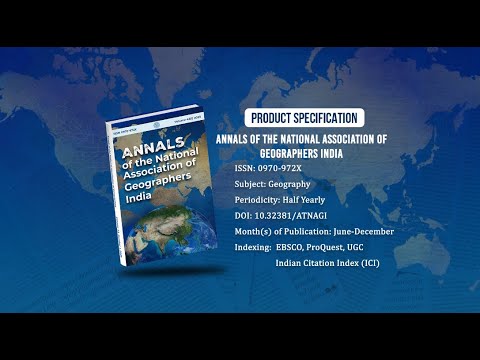
Annals of the National Association of Geographers India - A UGC-CARE Listed Journal
Published in Association with National Association of Geographers, India (NAGI)
Current Volume: 45 (2025 )
ISSN: 0970-972X
Periodicity: Half-Yearly
Month(s) of Publication: June & December
DOI: https://doi.org/10.32381/ATNAGI
Online Access is Free for All Life Member of NAGI
Assessing Livelihood Vulnerability in Diara with Special Reference to Flood: A Case Study of West Champaran District of Bihar
By : Manendra Kumar , Vijay Kumar Baraik
Page No: 93-109
Abstract
An extreme natural event can destroy or change the nature of livelihood of any region. In most part of the world, flood has been proved to be a major threat. Flood has destroyed millions of lives. The impact of flood is relatively higher in the states of Assam and Bihar, which face floods every year (Sinha, 2008; Mishra, 2007). Significant losses of life and property are witnessed. The devastation snatches away various livelihood capitals in these areas. Diara regions are found between river embankments (Hill, 1987; Kumari et al., 2018; Wadhnani and Singh, 2008) in the states of Bihar, West Bengal and Uttar Pradesh, etc. which face such vagaries of flood. All the perennial rivers flowing in the plain region have a land feature called Diara, known by different names locally. The term of ‘Diara’ can be used for that part of the riverbed, which is inundated during floods and remains dried during the post flood period. Villages located in the Diara region face the impacts of floods and drought every year. These are the most inaccessible and excluded villages of the plain region. This paper attempts to assess livelihood vulnerability in the Diara region of West Champaran district of Bihar. The study has used the data collected through conducting a primary household survey using a structured schedule, field observation, interviews and group discussions. The Livelihood Vulnerability Index was constructed using three sub-indexes of exposure, sensitivity and adaptive capacity. Out of the total sample households surveyed, 12.17 percent households had very high livelihood vulnerability, 35 percent households had high levels of livelihood vulnerability adding to a total of 47 percent households, which were in bad condition (very high + high) in terms of livelihood vulnerability.
Authors :
Manendra Kumar : Ph.D Research Scholar, Discipline of Geography, School of Sciences, IGNOU, New Delhi.
Vijay Kumar Baraik : Professor, Discipline of Geography, School of Sciences, IGNOU, New Delhi.
DOI: https://doi.org/10.32381/ATNAGI.2023.43.01.7